Monday, 28 May 2012

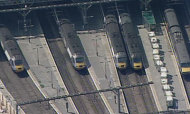
Unions: Govt Reforms Could Cost 20,000 Rail Jobs


More than 20,000 railway jobs could be axed under Government reforms of the industry, unions have warned.
Officials said surveys have consistently revealed that lack of staffing is a major concern of passengers, but they voiced fears cuts will be made as a result of the recent "value for money" review bySir Roy McNulty.
The unions claim the cuts would see job losses among guards, ticket office and station staff, maintenance workers and catering employees.
The TUC, Aslef, Rail Maritime and Transport union, Transport Salaried Staffs Association and Unite have launched a campaign aimed at opposing any cuts.
They will be handing out postcards to rail users across the country.
TUC deputy general secretary Frances O'Grady said: "The Government vision of a rail industry with deserted stations, closed ticket offices and trains with no staff is one that appeals to train operators seeking to cut costs and maximise profits - but train passengers are appalled."
Aslef general secretary Mick Whelan said: "In Victorian times we had three classes of coaches on the railways - first, second and third. These Government proposals would make the whole railway third class."
RMT general secretary Bob Crow said: "This Government, using the McNulty Rail Review as cover, is hell-bent on a policy of vandalising and de-staffing the railways regardless of the consequences for both staff and the travelling public."
Rail Performance Minister Norman Baker said: "Our plans are to reduce the cost of running the railway by £3.5bn per annum by 2019.
"If we can do this, we can reduce the burden on taxpayers and put an end to the era of above-inflation increases, as we are determined to do."

©SkyNews 2012

Terror suspect Qatada bail bid due


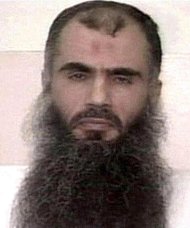
Jordanian terror suspect Abu Qatada could be freed as his bid for bail is heard.
Qatada, described by a judge as Osama bin Laden's right-hand man in Europe, will have his application for bail heard by a senior immigration judge in London. The radical cleric is being held in a high-security prison while he fights deportation to Jordan over terror charges.
The hearing will be held before Mr Justice Mitting at the Special Immigration Appeals Commission (Siac).
Qatada's 10-year battle against deportation is in the hands of the British courts after the 51-year-old lost his attempt to make a final appeal to Europe's human rights judges earlier this month.
His lawyers immediately applied for him to be released on bail as it looks likely that deportation proceedings will still take many months.
The political situation in Jordan has also worsened in recent months, casting fresh doubt on the UK's ability to deport him, they claim.
Repeated failed attempts by UK governments over the last 10 years to deport the radical cleric have cost nearly £1 million in legal fees, Government figures show.
No figures have been given for how much Qatada has received in legal aid and some estimates put the cost of keeping Qatada in the UK, either in a high-security jail or closely monitored under strict conditions in the community, along with the legal costs of the fight to deport him, at more than £3 million.
Qatada, who is said to have wide and high-level support among extremists, was convicted in his absence in Jordan of involvement with terror attacks in 1998 and faces a retrial in his home country. He also featured in hate sermons found on videos in the flat of one of the September 11 bombers.
Since 2001, when fears of the domestic terror threat rose in the aftermath of the attacks, he has challenged, and ultimately thwarted, every attempt by the Government to detain and deport him.

©Press Association

Sunday, 27 May 2012

Hague 'sickened' by Syrian massace


Foreign Secretary William Hague has said he was "absolutely sickened" by the massacre of more than 100 civilians, including dozens of children, in Syria.
Dismissing the the claims of President Bashar Assad's regime that it was not responsible for the slaughter, he called for international action to prevent Syria descending into a full civil war.

The Syrian charge d'affaires is to be summoned to the Foreign Office on Sunday to receive a dressing-down over the attacks on Houla, central Syria, which have provoked international uproar and condemnation.
"It is a familiar tactic of the Assad regime to blame others for what's happening in their country to try to get out of responsibility for the scale of the destruction," Mr Hague said.
"We are absolutely sickened in the British Government and across the international community by what we've seen over the last few days, in particular about the deaths of more than 100 unarmed men, women and children."
He said they were "more statistics" to add to a "huge total" that demonstrate the "brutality" of the regime, adding that the deaths "illuminate the type of tyranny that the people in Syria have been experiencing".
The UN Security Council was expected to convene this evening to discuss the massacre and Mr Hague was travelling to Moscow for talks with Russia's foreign minister. Russia and China have been the principal opponents of stronger action against the Syrian regime by the UN.
"It isn't in the interests of Russia, it's not in anyone's interests, for Syria to descend into an even bloodier situation and into a full-scale civil war and that's now the danger," Mr Hague added.
His comments came after the Syrian government flatly denied claims that its forces were responsible for the slaughter. Foreign ministry spokesman Jihad Makdissi said that Syria was being subjected to a "tsunami of lies" and claimed that anti-government gunmen carried out the attack.
After what was one of bloodiest episodes in the country's 14-month-old uprising, gruesome video footage emerged showing rows of dead Syrian children lying in a mosque with gaping head wounds. UN observers said the dead included 32 children under the age of 10.

©Press Association

Scottish drink-drive plans welcomed


Plans to lower the drink-drive limit in Scotland "as a priority" have been given a cautious welcome by road safety campaigners.
Justice Secretary Kenny MacAskill said proposals to lower the limit from 80mg of alcohol per 100ml of blood to 50mg will be brought forward later this year, "with a view to the change taking effect as soon as possible".
Campaigners hailed the plan as a step in the right direction, but said that a zero-tolerance approach remains their ultimate aim.
Sarah Fatica, general manager at Brake, the road safety charity, said: "We're pleased that the Scottish Government is taking heed of the warning that road safety charities and the EU are sending out about the current drink-drive limit.
"It's certainly a step in the right direction and one that we commend, and we would like to see the British Government also lowering the drink-drive limit. However, a 50mg limit does still leave some level of confusion for the general public about what is safe."
Ms Fatica said she would ultimately welcome a limit of 20mg or less, saying the "best message" to send out was one of zero tolerance for driving after drinking.
"Whilst 50mg is a step in the right direction, what we really need to see is a strong message from our Governments in Scotland and Westminster to say that not a drop is acceptable if you are behind the wheel.
"Far too many lives are lost on UK roads annually because of drink drivers. If we could have a zero-tolerance approach to drink driving, lives would obviously be saved."
Scottish Labour's justice spokesman, Lewis Macdonald, said: "This a welcome development and something I called for several weeks ago, so I am delighted that the Scottish Government are in listening mode.
"We need to get the details right, but the SNP will have our support on the issue as the Scottish Parliament works through the fine print."


©Press Association 2012

Scots Reveal Mixed Mood About Queen's Jubilee


Politics and history have helped shape a different relationship between Scotland and the monarchy than exists south of the border - creating a mixed mood for the Queen's Diamond Jubilee.
It is often said that republican sentiment and geographical distance disconnect Scots from the Monarch so often described as the "Queen of England".
A recent YouGov survey found that more Scots took national pride from comedian Billy Connolly than from the Queen.
Only 41% said the Queen made them proud to be Scottish while a total of 58% took national pride from Billy Connolly.
South of the border, 80% of people questioned said the Queen made them feel proud to be English.
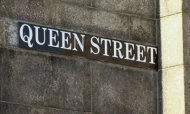
To gauge a Scottish view of the Queen Elizabeth II, and all things Diamond Jubilee, I took a walk down, where else, Queen Street - one in Aberdeen, the other in Edinburgh.
Here's who I met, and here's what they told me.
Councillor George Adam, Lord Provost of Aberdeen, who has his office in the council buildings on Queen Street:
"My view is that it's a tremendous opportunity for a bit of fun and a bit of entertainment, as well as recognising the fabulous service that the Queen has given to our country.
"It is an opportunity for the people across the UK, across the world, and in Aberdeen to celebrate that occasion.
"With the Royal connections in this area, there is just a love of the Queen in this area.
"So people are very supportive and I think they look at the tremendous service she's given the country and they see that it's something worth celebrating. 
"If you've been in a job that long, it's worth throwing a party."
Alison Blair, Aberdeen tax specialist:
"I'm not a supporter of the Royal Family, I'm afraid, so it doesn't interest me. I couldn't tell you what day it is or anything about it and I don't think a lot of people in Scotland are.
"I think there's a lot of disinterest in the Royal Family, particularly in Scotland, because they're so far away. 
"It doesn't with meet peoples' realistic ideas and goals and, especially with the recession and everything, I think it's the last thing on people's minds - they've got more to worry about."
Gordon McKay is the owner of McKay's outdoor wear shop, which has had a presence on Aberdeen's Queen Street for more than a century. 
His shop front is decorated with Union flags and he fondly remembers the day of the Queen's coronation in 1953: "Being at school, at that age, you got very excited about things and it brought a bit of colour into what was a very drab Britain at that particular time.
"It gave the whole country quite a lift. I recall that we all got a small blue Bible and a tin of chocolates which in itself, for a child, was a good thing.
"After that we went to the local cinema to see it on the screen, which was magnificent as well, to see all the colour and pageantry at that particular time."
Newton Faulkner, musician, is a native of Kent. I found him sound-checking for a gig later that night in the Lemon Tree venue on Aberdeen's Queen Street:
"I'm not unsupportive, it's just not something I think about very often. I know that sounds bad, it's probably a generational thing.
"It's definitely not a bad thing and it's obviously a huge part of our heritage but, beyond that, it doesn't take up a huge amount of brain space for me."
Jim Fairgrieve, a cobbler on Queen Street, Edinburgh: "I'm a supporter of the Queen but not so much the other people involved, the hangers-on.
"She brings revenue into the country but they cost the country money. She's the Queen not only of this country but also of Australia and places like that and she's got a good reputation.
"She's achieved a lot and she's been good for the country."
Susan Mitchell, a shopper on Queen Street, Edinburgh: "I've absolutely nothing against the Queen and I appreciate that she works hard for the country. However, I don't have any interest in the celebrations.
"In fact, I couldn't even tell you when it is. I hope everyone planning to take part has a good day, though, and enjoys the occasion - the Queen and her family included!"
Comedian Des Clarke, performing at The Stand comedy club, just off Edinburgh's Queen Street: "The Queen? I think most people, generally, quite like the Queen. She gets to go out in public and wave jewellery - she is, sort of, like Britain's Mr T.
"She's done it for quite a long time and I think that anyone, in this current economic climate, who can stay in a job for 60 years - she must be doing well for herself.
"The relationship between Scotland and the Queen is quite interesting. 
"Will we be having lots of street parties? No. Are we glad we're getting a couple of days off work? Yes. 
"So I think anybody who can get us time off and have an extra couple of days drinking is always going to go down well in Scotland."

©SkyNews 2012
Saturday, 26 May 2012

Jubilee: Britons Set For Big Spending Spree


Britons are expected to spend more than £800m celebrating the Queen's Jubilee, according to new research.
The figures is almost twice as much as the country spent during last year's Royal wedding festivities, said moneysupermarket.com.
The online price comparison site survey estimates that people celebrating next week's event plan to spend an average of £40 on Jubilee-related items.
"Our research has shown the British public is gripped by Jubilee fever with almost half of us keen to mark the 60th anniversary of the country's longest reigning monarch," said Clare Francis from the website.
"With an extra day off work for most, it makes sense that people want to mark the occasion with a celebration of their own and that many plan to buy a keepsake."
The findings are in stark contrast to warnings from senior economists that the extra bank holiday will have a negative effect on the British economy.
"The greatest areas of disruption may be in areas like manufacturing because you might have at that time more extended shutdowns at plants," said Ross Walker, chief economist for Royal Bank of Scotland.
"You may get disruptions to the supply chain which could hit production industries more than other sectors so manufacturing seems particularly vulnerable but I think it will be quite broad-based."
But some manufacturers are rubbing their hands with glee as the Jubilee creates a surge in orders.
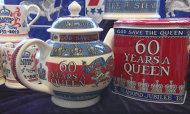
The Emma Bridgewater pottery at Stoke-on-Trent is set to double its predicted sales - with £1.5m worth of commemorative products.
Demand has far outstripped Royal wedding sales with major retailers increasing orders up to sevenfold.
The company expects to make more than 200,000 pieces of Diamond Jubilee ware. 
One item - a crown-shaped dish with lid priced at £100 - was predicted to sell 300 and more than a thousand have already been sold.
Co-owner Matthew Rice said: "We have never seen demand such as this. When people are happy, they spend money. When people are sad they don't. It's as simple as that. 
"These are happy, brilliant events and they will stimulate trade. It's good for the country - as is a day off."
He has harsh words to those who say the Jubilee is bad for business.
"I think 'bah humbug!' is the phrase for that. Get a grip! Shut the doors! Get out and have a good time. If you are so sold on your business that you can't enjoy a few days of bank holiday, then something has gone very wrong with your life," he said.
North Yorkshire flag making firm 'Flying Colours' agrees. Owner Andy Ormrod said the firm had received orders for Union flags from ex-pats in Australia, Europe, America and it started snowballing from there.
"Since January it has just been amazing. The orders are coming from British business, Councils, corporations, theme parks... You name it."
Analysts will have to wait until the economic figures are out for the second quarter for an accurate reflection of the Jubilee effect.

©SkyNews 2012

Friday, 25 May 2012

Hunt's Ex-Special Adviser: I Was Told To Quit


Culture Secretary Jeremy Hunt's former special adviser has told the Leveson Inquiry he was told to resign after damaging emails revealing the close relationship between his department and the Murdoch empire were released.
Ex-aide Adam Smith said the Secretary of State had reassured him that he had only been doing his job and not to worry on the evening the documents were published.
But the following day Mr Hunt spent the morning in meetings before calling in Mr Smith and telling him "everyone here thinks you need to go", he told the inquiry.
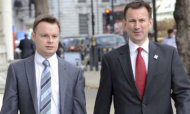
Mr Smith, 30, resigned last month after admitting his contacts with News Corporation lobbyist Fred Michel had got too close.
Mr Smith told the inquiry into media ethics that Mr Michel"bombarded" him with information about the BSkyB bid, but said he ignored much of that correspondence.
The inquiry heard yesterday that Mr Michel exchanged 191 telephone calls, 158 emails and 799 texts with Mr Hunt's team between June 2010, when News Corpannounced its bid, and last July, when it abandoned the plan amid outrage over the News Of The World phone-hacking scandal.
Of these, more than 90% were exchanged with Mr Smith, who sent 257 texts to Mr Michel between November 2010 and last July.
Mr Smith insisted he had not been given any specific instructions by Mr Hunt or civil servants on his role in the decision on BSkyB, owner of Sky News.
Meanwhile, it has emerged that the embattled Culture Secretary will be grilled over his links with News Corp on Thursday.
Mr Hunt is under intense pressure following the publication by the inquiry yesterday of a memo in which he made private representations to the Prime Minister supporting News Corp's bid just weeks before he was given the role in the quasi-judicial decision.
But David Cameron has sprung to his defence, saying Mr Hunt acted "impartially" once he was made responsible for overseeing the BSkyB takeover bid.
"I don't regret giving the job to Jeremy Hunt, it was the right thing to do in the circumstances, which were not of my making," Mr Cameron told ITV's This Morning.
"The crucial point, the really crucial point, is did Jeremy Hunt carry out his role properly with respect to BSkyB and I believe that he did."
Mr Hunt was given the role after Business Secretary Vince Cable was stripped of the responsibility over comments made to undercover journalists.
The memo, dated November 19, 2010, warned that News Corp's James Murdoch was "furious" about Mr Cable 's handling of the matter.
It also expressed concerns that referring the bid to Ofcom could leave the Government "on the wrong side of media policy".
As well as Mr Hunt, other key witnesses to appear before Lord Justice Leveson next week include former prime minister Tony Blair, Education Secretary Michael Gove, Home Secretary Theresa May, Mr Cable and Justice Secretary Ken Clarke.
Jonathan Stephens, the top civil servant in Mr Hunt's department, is now giving evidence to the inquiry.
Mr Stephens, permanent secretary at the Department for Culture, Media and Sport, has admitted that the correspondence between Mr Smith and News Corp was a "calamity" for the department.
He added that although Mr Smith was "young, able and well-intentioned" he had been "drawn into a web of manipulation".
Mr Hunt is now facing renewed calls from Labour MPs to resign following the publication of yesterday's memo.
Labour deputy leader Harriet Harman told Sky News: "Mr Hunt said he would act impartially but he wasn't impartial because he had already made up his mind.
"Yesterday, it became clear the Prime Minister should have never given Mr Hunt the responsibility to make this decision because he himself knew that Mr Hunt was not impartial and he was already backing the bid.
"Even prior to the memo Mr Hunt had been warned by his civil servants that he had to stop meeting with the Murdochs because he was meddling with the bid."
But Downing Street has played down its significance, pointing out that Mr Hunt had already made supportive comments about the bid in press interviews earlier that year.