As polling stations prepare to open in Greece many people still haven't made up their minds about which way to go.
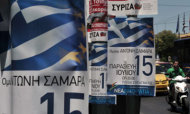
And with the two leading parties reportedly very close, those undecided and volatile voters could swing the election.
Sunday's crucial vote could lead to Greece crashing out of the eurozone, sparking economic chaos across Europe.
Former British prime minister Gordon Brown claimed the prospect of a "chaotic" Greek exit from the eurozone is growing more likely regardless of the election result.
And he warned next week's G20 summit in Mexico is the "last chance" to sort out the single currency crisis.
European leaders pledged last night to take the "necessary action" needed to secure global economic stability in a video conference call with David Cameron setting the groundwork to the meeting of leading economies.
As Greece's second election in six weeks approaches, Dimitrios Papadimitrious, a 25-year-old taxi driver, told Sky News: "Most young people don't know what to do. They know the election is the last chance to get rid of the political parties of the past and change things but they are afraid. Afraid of the unknown. Afraid of the unexpected."
He cites the leader of the centre-right New Democracy Party Antonis Samaras who used the last rally of the campaign to tell people that the election is a choice between staying in the euro and going back to the drachma .
"On the TV everyday they are saying that voting the wrong way could cause a terrible accident and push us out of the eurozone.
"They tell us if that happens our lives will be destroyed. That we won't be able to buy basic things. We won't be able to get oil for our cars. They paint terrible dilemmas which make people afraid."
And that fear seems to be causing a kind of paralysis with some voters. Their instinct, like six weeks ago, may be to give the established parties and politicians a bloody nose, but then they ask "who can I trust?"
Mother of three Stella Tsarpali wonders if she can trust anyone. She and her husband have lost their jobs. They have also lost faith in politics and politicians.
"I don't know what to think anymore," she says outside the charity near Athens where she has been forced to go for food donations to make ends meet.
After she and her husband lost their jobs they also lost faith in politics and politicians.
She cries as she says: "They (the politicians) created this mess. They did it. I had to sell my possessions, my jewellery to help my children. I have nothing else to sell. The politicians brought us to this. I don't know what to think anymore."
She says she doesn't know who to vote for. She doesn't even know if she will vote.
And her sentiment is echoed across Greece. You get the strong sense here that passion for politicians has diminished. You get the sense that for many the choice on Sunday is for the lesser of evils rather than a positive pick.
Even those with time on their hands to ponder the alternatives struggle. On a picket line outside the capital sit striking steel workers - involved in the longest industrial action seen in recent Greece.
They have been out for more than 200 days and the worry beads in the hands of many of the men betray a fear which is largely unspoken.
They took action accusing their employer of opportunism, of using the climate of austerity to force through cuts and savings.
But the shared opposition to their boss does not extend to a shared vision of how things can improve in their country. Friends and colleagues Haris Manolis and Argiris Chatziyannikis argue over Greece should stay in or out of the Euro.
Haris says: "I will vote for a party that gets us out of the eurozone, out of Europe. We can survive without Europe."
No says Argiris: "Europe is a family. And if something goes wrong in that family we help each other. It is important."
Both think they will vote for smaller parties but neither seems confident about the immediate future here. There is a sense of, if not fatalism, resignation. An acceptance that, whoever triumphs in the election, nothing will change overnight.
And that will make for a result which is unlikely to be celebrated in the way of normal political triumphs.
Even the leaders know winning will not necessarily be a positive endorsement. Just the 'least bad option'. And whoever wins knows there will be no time for partying with so much critical work to be done.