Showing posts with label greece. Show all posts

Sunday, 17 June 2012

Greek People 'Have Voted For The Euro'


The Greek people have voted in favour of staying in the euro, New Democracy leader Antonis Samaras has told reporters after his party were projected to win the election.
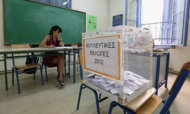
The pro-euro conservative party will win the election with 29.5% of the overall vote - just ahead of the radical left Syriza party on 27.1%, according to an official projection.
That means New Democracy will be the biggest single party with 128 seats in the single-tier parliament - but it will not have an overall majority.
However, the conservatives could gather enough support to form a pro-bailout coalition with the socialist Pasok party to keep the country in the eurozone.
Official projections show Pasok will win 12.3% of the overall vote and 33 seats.
Syriza's leader Alexis Tsipras has phoned the leader of New Democracy, Antonis
Samaras, and told him to go ahead and form a government.
After 15% of the votes counted, New Democracy had taken a 31.1% share of the vote, while Syriza was running second with 25.4% of the vote.
After polling stations closed at 7pm local time, the first exit poll suggested it would be neck-and-neck between the conservatives and the radicals.
The poll showed New Democracy taking between 27.5%-30.5% of the vote, while Syriza was just behind with 27%-30%.
They were followed by the Pasok socialists with 10%-12% of the vote.
An updated exit poll two hours later put New Democracy ahead by slightly more, with 28.6%-30% of the vote.
The result of this election could determine the country's future in Europe, and that of the single currency.
New Democracy is committed to keeping Greece within the euro and has vowed to negotiate with Greece's creditors to ease the bailout conditions and try to boost economic growth.
But the anti-bailout Syriza had promised to rip up the current agreement - a move many believe would force Greece to leave the eurozone.
Roughly, a single party would need between 36%-38% to have an overall majority - and the figures show the two lead parties well below that.
If neither side achieves a majority, they will both be looking to cut a deal.
Of the 300 seats in parliament, 250 will be awarded according to the share of the vote - the remaining 50 will be given to the party which receives the most support.

Saturday, 16 June 2012

Euro Hangs In Balance Ahead Of Greek Election


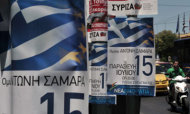
As polling stations prepare to open in Greece many people still haven't made up their minds about which way to go.
And with the two leading parties reportedly very close, those undecided and volatile voters could swing the election.
Sunday's crucial vote could lead to Greece crashing out of the eurozone, sparking economic chaos across Europe.
Former British prime minister Gordon Brown claimed the prospect of a "chaotic" Greek exit from the eurozone is growing more likely regardless of the election result.
And he warned next week's G20 summit in Mexico is the "last chance" to sort out the single currency crisis.
European leaders pledged last night to take the "necessary action" needed to secure global economic stability in a video conference call with David Cameron setting the groundwork to the meeting of leading economies.
As Greece's second election in six weeks approaches, Dimitrios Papadimitrious, a 25-year-old taxi driver, told Sky News: "Most young people don't know what to do. They know the election is the last chance to get rid of the political parties of the past and change things but they are afraid. Afraid of the unknown. Afraid of the unexpected."
He cites the leader of the centre-right New Democracy Party Antonis Samaras who used the last rally of the campaign to tell people that the election is a choice between staying in the euro and going back to the drachma .
"On the TV everyday they are saying that voting the wrong way could cause a terrible accident and push us out of the eurozone.
"They tell us if that happens our lives will be destroyed. That we won't be able to buy basic things. We won't be able to get oil for our cars. They paint terrible dilemmas which make people afraid."
And that fear seems to be causing a kind of paralysis with some voters. Their instinct, like six weeks ago, may be to give the established parties and politicians a bloody nose, but then they ask "who can I trust?"
Mother of three Stella Tsarpali wonders if she can trust anyone. She and her husband have lost their jobs. They have also lost faith in politics and politicians.
"I don't know what to think anymore," she says outside the charity near Athens where she has been forced to go for food donations to make ends meet.
After she and her husband lost their jobs they also lost faith in politics and politicians.
She cries as she says: "They (the politicians) created this mess. They did it. I had to sell my possessions, my jewellery to help my children. I have nothing else to sell. The politicians brought us to this. I don't know what to think anymore."
She says she doesn't know who to vote for. She doesn't even know if she will vote.
And her sentiment is echoed across Greece. You get the strong sense here that passion for politicians has diminished. You get the sense that for many the choice on Sunday is for the lesser of evils rather than a positive pick.
Even those with time on their hands to ponder the alternatives struggle. On a picket line outside the capital sit striking steel workers - involved in the longest industrial action seen in recent Greece.
They have been out for more than 200 days and the worry beads in the hands of many of the men betray a fear which is largely unspoken.
They took action accusing their employer of opportunism, of using the climate of austerity to force through cuts and savings.
But the shared opposition to their boss does not extend to a shared vision of how things can improve in their country. Friends and colleagues Haris Manolis and Argiris Chatziyannikis argue over Greece should stay in or out of the Euro.
Haris says: "I will vote for a party that gets us out of the eurozone, out of Europe. We can survive without Europe."
No says Argiris: "Europe is a family. And if something goes wrong in that family we help each other. It is important."
Both think they will vote for smaller parties but neither seems confident about the immediate future here. There is a sense of, if not fatalism, resignation. An acceptance that, whoever triumphs in the election, nothing will change overnight.
And that will make for a result which is unlikely to be celebrated in the way of normal political triumphs.
Even the leaders know winning will not necessarily be a positive endorsement. Just the 'least bad option'. And whoever wins knows there will be no time for partying with so much critical work to be done.

Wednesday, 4 April 2012

'So I Won't Leave Debts for My Children': Man Commits Suicide to Protest Greek Economic Crisis


A 77-year-old Greek man took his life in Athens' central Syntagma Square early Wednesday, police said, in what appeared to be a protest against a deepening economic crisis that has coincided with a rising national suicide rate.
The man shot himself with a handgun several hundred meters from the entrance to the Greek parliament building in a grassy area to one side of the Greek capital's main square.
According to state-owned NET television, the man was a former pharmacist and left behind a suicide note, that appeared to liken Greece's current crisis to the deep poverty the country suffered during the World War II German occupation.
"I have no other way to react apart from finding a dignified end before I start sifting through garbage for food," the suicide note said according to NET.
Police spokesman Panagiotis Papapetropoulos said authorities weren't aware of a note. The police haven't disclosed the identity of the man or other details, pending notification of the next of kin.
"There was a suicide involving a 77-year-old man in Syntagma Square," Papapetropoulos said, adding that the police were investigating the incident.
Eyewitnesses said the man was in apparent despair over his financial debts, shouting just moments before killing himself: "So I won't leave debts for my children."
Following the shooting, groups of Athenians stopped by the point where the suicide took place in order to leave flowers and sympathy notes.
Government spokesman Pantelis Kapsis described the suicide as "a human tragedy" that took place under unknown conditions.
"We must all be calm and respect the real causes (of the suicide), which are not yet known," he said.
The suicide also evoked sympathetic responses from a series of Greek politicians who blamed the austerity for the incident.
Greece is now in its fifth year of a grinding economic recession made worse by successive waves of austerity measures the country has taken to meet the demands of its international creditors from the European Union and the International Monetary Fund.
Those various austerity measures have led to steep cuts, in some cases more than 25%, in retiree pensions and other benefits. At the same time many Greeks are being squeezed by declining wages and higher taxes on everything from property to petrol.
"This was a symbolic suicide. If it hadn't happened here, in the square, in front of parliament, no one would notice," said one bystander, who declined to give his name but who heard the shots from across the square.
The social impact of the economic crisis has become increasingly apparent on the streets of Athens and other cities, while suicide rates have jumped. In one notable case last September, a Greek man in his 50s who was struggling with his debts attempted suicide in front of a bank branch in the northern city of Thessaloniki by setting himself on fire.
According to police data, the number of suicides in both 2010 and 2011 surpassed 600 each year, a 20% jump over the rate in 2009, the year before the start of the Greek debt crisis.